Android Is Becoming an AI Operating System
How Google is transforming Android from a mobile OS into an AI-first ecosystem powered by Gemini.
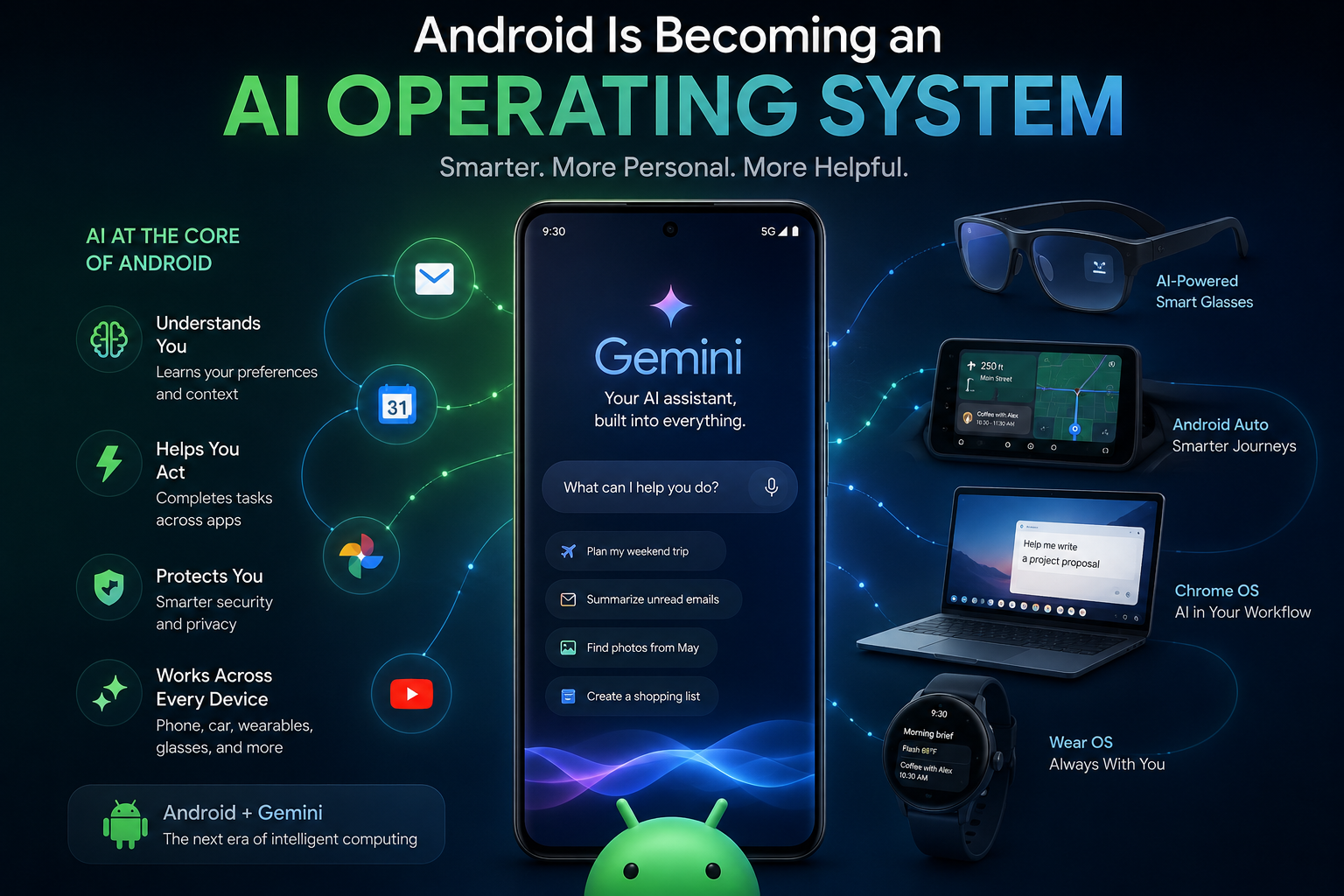
For years, Android was simply a mobile operating system — an ecosystem for apps, notifications, and touch interactions. But in 2026, that definition is changing rapidly.
Google is no longer treating Android as just software for smartphones. Instead, it is transforming Android into an AI operating system, where artificial intelligence becomes the layer that powers everything users do.
At the center of this shift is Gemini, Google’s flagship AI model.
From phones and tablets to cars, smart glasses, Chrome, and wearables, Android is evolving into a deeply connected AI ecosystem designed to understand context, predict intent, and assist users in real time.
This could become the biggest transformation in personal computing since the smartphone itself.
The Shift From Apps to AI
Traditional smartphones revolve around apps.
Need food? Open an app.
Need directions? Open Maps.
Need information? Open a browser.
Google’s new AI vision changes that model entirely.
Instead of forcing users to jump between apps, Gemini acts as an intelligent layer sitting above the operating system. Users can ask for tasks naturally, and AI handles the workflow behind the scenes.
Examples include:
- Summarizing emails instantly
- Planning trips using Gmail and Maps together
- Generating replies across messaging apps
- Searching photos using natural language
- Managing tasks without opening multiple apps
The interface is becoming conversational rather than app-driven.
This is a major philosophical change for Android.
Gemini Is Becoming the Core of Android
Google has integrated Gemini deeply into Android across multiple products and services.
Rather than existing as a separate chatbot, Gemini now powers:
- Android phones
- Chrome browser
- Google Workspace
- Smart devices
- Android Auto
- Wearables
- Future AR glasses
The goal is simple:
Make AI the default interaction layer across Google’s ecosystem.
This means Android devices will increasingly understand:
- What you’re doing
- What you need next
- Your habits and preferences
- Context across apps and devices
In many ways, Android is becoming less of an operating system and more of a personal AI environment.
AI Will Replace Traditional Navigation
One of the biggest implications of AI-powered Android is the decline of manual app navigation.
Today:
- Users search
- Tap
- Scroll
- Switch apps repeatedly
Tomorrow:
- Users simply ask
For example:
“Book me the cheapest flight for next weekend and add it to my calendar.”
Instead of manually opening five apps, the AI handles the entire workflow.
This introduces the era of agentic AI — systems capable of completing multi-step tasks autonomously.
Google is betting heavily on this future.
Smart Glasses and Ambient Computing
Another major trend is the return of smart glasses.
Google recently demonstrated AI-powered wearable concepts that integrate Gemini directly into visual interfaces.
These devices could:
- Translate conversations live
- Provide contextual information instantly
- Navigate users in real time
- Act as always-available AI assistants
Combined with Android, this creates what many call ambient computing — technology that fades into the background while AI handles interactions naturally.
The smartphone may eventually become secondary.
Personalized AI Comes With Risks
The more AI understands users, the more powerful it becomes.
But personalization introduces major privacy concerns.
Gemini can now connect across:
- Gmail
- Photos
- Calendar
- YouTube
- Search history
- Documents
This creates a highly personalized assistant capable of remembering preferences, habits, and routines.
The convenience is enormous.
However, critics argue this level of integration raises serious questions about:
- Data privacy
- Surveillance
- AI manipulation
- Digital dependency
As Android becomes more intelligent, users may need to trade more personal data for convenience.
The Real Competition Isn’t Apple
While Android and iPhone still compete traditionally, the real battle has shifted toward AI ecosystems.
The future winners may not be the companies with the best hardware.
Instead, they may be the companies with:
- The smartest AI
- The best context awareness
- The strongest AI infrastructure
- The deepest ecosystem integration
Google, OpenAI, Microsoft, Anthropic, and Apple are all racing toward this future.
Android gives Google a massive advantage because billions of devices already run its software.
Why This Matters
The transformation of Android into an AI operating system signals a much larger shift in computing.
We’re moving from:
- Apps → AI agents
- Search → conversation
- Manual workflows → automation
- Phones → ambient devices
This isn’t just another Android update.
It’s the beginning of AI-native computing.
And over the next few years, users may interact less with apps and more with intelligent systems that operate invisibly in the background.
The operating system is no longer just software.
It is becoming an assistant.
Final Thoughts
Google’s AI strategy suggests that the future of Android is not centered around smartphones alone.
Instead, Android is evolving into an intelligent AI platform that connects devices, understands context, and automates digital life.
Whether this future becomes empowering or invasive depends on how responsibly AI companies build these systems.
But one thing is already clear:
The next era of computing will be AI-first.
And Android intends to lead it.