Training Their Replacements: The Story Behind India's Headcam Workers
Thousands of Indian workers are strapping cameras to their heads and recording their every move — all to teach robots how to be human. Here's the full story: who's paying, who's profiting, and what it means for the future of work in India.
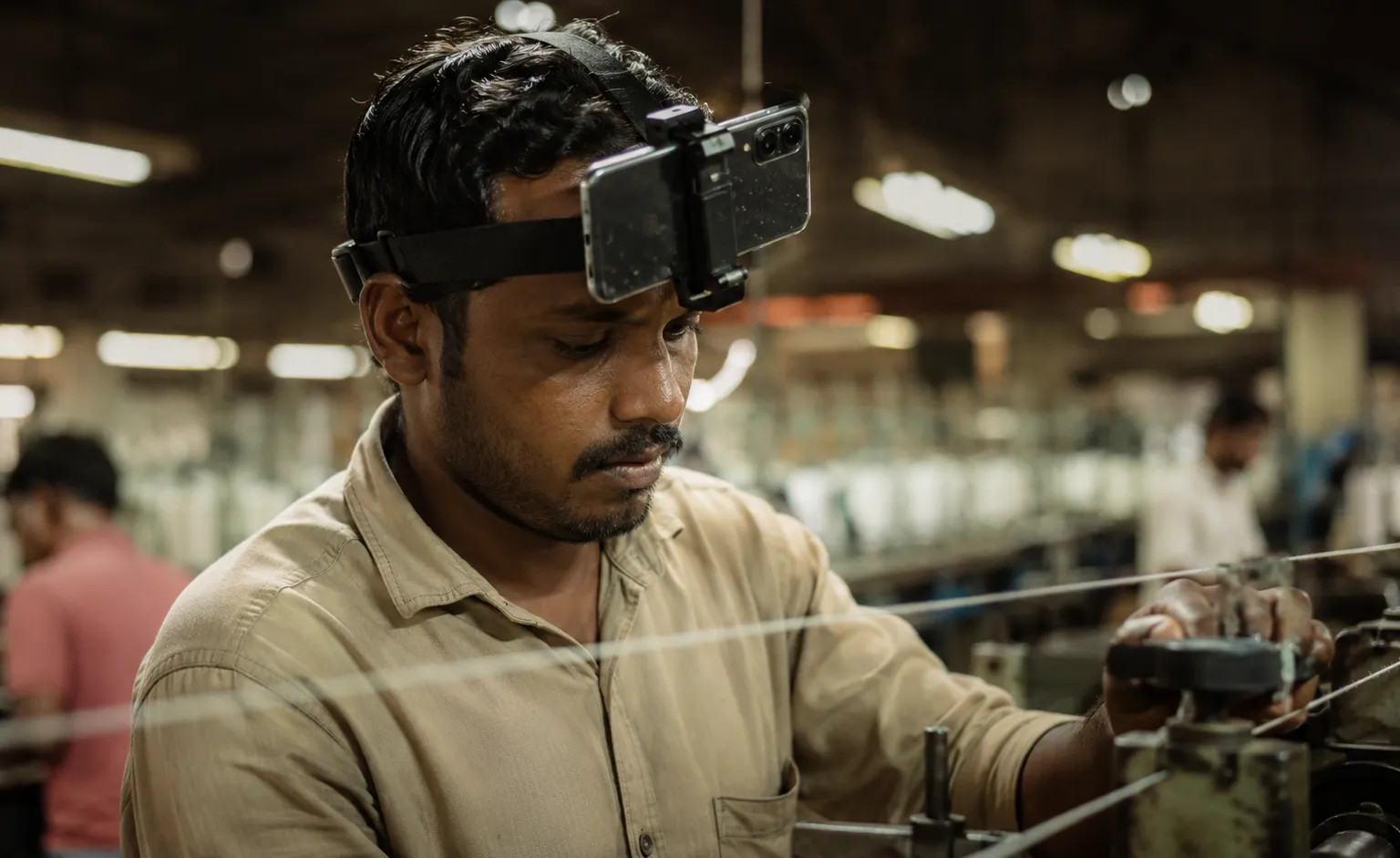
“The workers are training their own replacements in real time, on the job, getting paid to do it.”
— Viral social media post, April 2026
If you’ve been in a factory area, marketplace, or even a busy street in India lately, you may have spotted something strange: ordinary workers — textile labourers, vegetable vendors, warehouse staff — wearing phone mounts or small cameras strapped to their foreheads, recording their every move.
It looks like something out of a sci-fi film. But it’s very real, very widespread, and the implications run far deeper than a ₹350/hour gig.
What Is Actually Happening?
These workers are participating in egocentric data collection — a booming new segment of the AI economy. “Egocentric” simply means first-person, point-of-view footage. The head-mounted camera captures exactly what the worker sees: how their hands grip objects, how their wrists rotate, how they adjust when something shifts unexpectedly.
This footage is gold for AI companies building the next generation of robots and automated systems.
Robots can already perform rigid, pre-programmed tasks in controlled environments. But teaching them to handle the unpredictable messiness of the real world — the slightly different angle of a screw, the give of a fabric, the weight of a half-full cup — is extraordinarily difficult. You can’t just write code for that. You have to show a machine millions of real human examples.
That’s exactly what these workers are providing.
Tasks recorded typically include:
- Picking up, placing, and stacking objects
- Sorting items by size, colour, or shape
- Using tools like screwdrivers, scissors, and utensils
- Folding laundry, washing dishes, cooking
- Cleaning and wiping surfaces
- Reaching and placing objects at varying distances
Every hand movement, every subtle adjustment, every unconscious human shortcut — all of it captured, uploaded, processed, and fed into AI training pipelines.
Who Is Paying for This Data?
Here’s where it gets interesting. The money trail goes through several layers:
🇮🇳 Indian Data Aggregators (The Middlemen)
Egolab.AI is perhaps the most notable example — a company founded in January 2026 by two teenagers from Maharashtra: Raghav Samani (19, from Sangli) and Varun Pareek (18, from Ichalkaranji). They describe themselves as “India’s largest first-person POV Data Aggregator,” collecting high-quality, labour-sourced egocentric video footage from factory workers using lightweight cameras, then packaging it into datasets for global AI companies. In March 2026, Egolab was acquired by Build Artificial Intelligence Inc. (Build AI), an American firm registered in Delaware and headed by 19-year-old Edward Xu and 21-year-old Jonathan Jia — for a reported seven-figure sum.
Micro1, a US company based in Palo Alto, has hired thousands of contract workers across more than 50 countries including India, Nigeria, and Argentina. They have approximately 4,000 “robotics generalists” across 71 countries, who collectively submit over 160,000 hours of video each month.
🌍 Global Tech Giants (The End Buyers)
The data ultimately flows to the companies building humanoid robots and physical AI systems:
| Company | What They’re Building |
|---|---|
| Tesla (Optimus) | Humanoid robot for factories & homes |
| Figure AI | General-purpose humanoid robots |
| Agility Robotics | Warehouse humanoid (Digit) |
| Boston Dynamics | Advanced industrial robots |
| Scale AI | AI data platform supplying multiple robotics firms |
| Encord | Data annotation platform for physical AI |
Additionally, companies like DoorDash have experimented with paying their delivery workers to film themselves doing household chores — an unexpected crossover between the gig economy and robotics training.
Why India? Why Now?
India has become ground zero for this data rush for three core reasons:
- Scale — A workforce of 500+ million workers across manufacturing, agriculture, textiles, and logistics offers an enormous, diverse “data library” of human movement.
- Cost — At ₹250–350/hour (roughly $3–4 USD), Indian data collectors cost a fraction of their counterparts in the US or Europe, where similar roles can pay $17/hour or more.
- Manufacturing Density — Clusters in Tamil Nadu (textiles), Gujarat (manufacturing), and Maharashtra (industrial) provide rich, varied environments for data capture.
Investors poured over $6 billion into humanoid robots in 2025 alone, and the race to build physically capable AI is only accelerating. India sits at the most convenient intersection of need and supply.
The Benefits: Who Gains?
For Workers
- Supplementary income — ₹350/hour is competitive for gig work, particularly for factory and informal sector workers
- Low barrier to entry — No technical skills required; just follow instructions
- Flexible hours — Most programs are part-time and remote/at-home
- Some social mobility — Early data collectors in comparable programs abroad have used the income to fund education or transition into tech-adjacent roles
For India’s Economy
- New export category — Human movement data is becoming as valuable as software exports
- Gig economy expansion — A new category of gig work that doesn’t require a smartphone app or vehicle
- Youth entrepreneurship — The Egolab story shows young Indians building valuable companies at the intersection of local labour and global AI demand
For AI & Robotics Companies
- Higher quality training data — Real-world, diverse human motion that simulations simply cannot replicate
- Faster development cycles — More data means robots reach functional capability sooner
- Cost efficiency — Dramatically cheaper data acquisition compared to lab-based collection
For Society (Long Term)
- Better assistive robots — Well-trained robots could assist elderly people, handle dangerous tasks, or work in environments harmful to humans
- Potential productivity gains — Automation, done right, can free humans for higher-value, more creative work
The Losses: Who Pays the Price?
The Automation Paradox
The most uncomfortable truth is hiding in plain sight: the workers collecting this data may be directly training the systems that will eliminate their jobs.
Textile workers in Tirupur documenting how to fold a garment. Factory hands in Gujarat recording how to assemble a component. Each hour of footage is a lesson for a machine that, once trained, will work 24 hours a day, never demand a raise, and never call in sick.
Job Displacement at Scale
India’s manufacturing sector employs hundreds of millions of people. The International Labour Organization estimates that automation could affect up to 69% of jobs in India over the coming decades. The data collection boom isn’t creating a new industry — it’s accelerating the timeline of the very disruption it profits from.
Worker Rights & Consent Issues
- Are workers fully informed about what they’re training and what the long-term implications are?
- Most contracts are short-term gig arrangements with no benefits, no job security, and no stake in the value they’re creating
- The seven-figure acquisition of Egolab was built entirely on the labour of workers who received nothing beyond their hourly rate
Privacy & Biometric Data Concerns
Head-mounted cameras don’t just capture hand movements. They record:
- Faces of co-workers, family members, strangers
- Home interiors (for at-home recording gigs)
- Workspaces, potentially exposing proprietary processes
- Biometric movement patterns that could theoretically be used to identify individuals or assess fatigue and emotional state
India’s data protection framework is still evolving and currently offers limited specific protections for this kind of biometric movement data.
Concentration of Wealth
The economic value flows almost entirely upward. A worker earns ₹350/hour. The data is packaged and sold to a company worth billions. The robots trained on that data generate returns worth orders of magnitude more — and the worker sees none of it.
The Bigger Picture: Large Behaviour Models
What these workers are actually building — without most of them knowing the technical term — are datasets for Large Behaviour Models (LBMs). Think of LBMs as the physical-world equivalent of the large language models (like the AI powering chatbots): instead of learning language patterns from billions of text examples, LBMs learn physical action patterns from billions of movement examples.
Just as GPT learned to write by reading the internet, robots will learn to move by watching humans. And right now, the humans they’re watching are largely in India, Nigeria, and Argentina — paid fractions of what their data is worth.
What Should Happen Next?
Several voices in the tech and labour policy space are calling for:
- Data dividends — A share of the downstream value generated by AI trained on worker data, paid back to the workers who created it
- Informed consent protocols — Workers must understand exactly what they’re contributing to before signing contracts
- Biometric data regulation — India’s upcoming data protection laws must specifically address movement and behavioural data
- Skill redirection programs — Using the same camera and AR technology to retrain workers as robot supervisors and technicians, not just data sources
- International data labour standards — A global framework for fair compensation in AI training data work, similar to fair trade in goods
The Bottom Line
The headcam workers you’re seeing on the streets and factory floors of India are not doing something trivial. They are literally teaching machines to be human — one hand movement, one grip, one adjustment at a time.
Whether that leads to a future of human-robot collaboration and shared prosperity, or a future of mass displacement and concentrated wealth, depends almost entirely on the policy and business decisions made in the next few years.
The cameras are rolling. The question is: who controls what happens after the footage is uploaded?
Sources: Business Standard, Scroll.in, MIT Technology Review, Free Press Journal, Let’s Data Science (May 2026)
Discussion
Sign in with GitHub to join the conversation.